

Every American small business owner knows the frustration of watching competitors get found first on Google while your own phone stays quiet. Without clear insights into how you appear in local search, it is difficult to tell if your website or Google Business Profile is working for you. By understanding local search engine optimization and simple tracking, you can finally see what drives customer inquiries and stop guessing about your online presence.
Table of Contents
- Defining SEO Tracking For Local Businesses
- Main Types Of SEO Tracking Metrics
- How SEO Tracking Improves Results
- Key Tools And Methods For SEO Tracking
- Common Mistakes And Costly Pitfalls
Key Takeaways
| Point | Details |
|---|---|
| Understand Local SEO Tracking | Monitor your business performance in local search results to determine visibility for relevant searches. Use metrics to measure where your business ranks and how many potential customers are engaging with your site. |
| Focus on Key Metrics | Concentrate on essential metrics like keyword rankings, organic traffic, and conversion rates instead of overwhelming yourself with excessive data. Choose metrics that directly impact your business growth. |
| Use Effective Tools | Leverage free tools like Google Analytics and Google Search Console for comprehensive tracking. Consider integrating additional tools for more detailed insights as your understanding of SEO tracking grows. |
| Avoid Common Mistakes | Steer clear of tracking vanity metrics that don’t convert and black-hat SEO tactics that can jeopardize your website’s standing with search engines. Always seek context in your data to make informed decisions. |
Defining SEO Tracking for Local Businesses
SEO tracking is simply watching how your business appears in search results and measuring what’s working. For local businesses, this means monitoring whether customers in your area can find you when they search for services like yours on Google. When a customer searches “plumber near me” or “coffee shop downtown,” SEO tracking helps you understand if your business shows up, where it ranks, and how many people actually click through to contact you. It’s the difference between hoping people find you and knowing exactly what’s happening when they search.
Local search engine optimization focuses specifically on appearing in results for searches tied to your geographic location. Unlike traditional SEO that targets a national or international audience, local SEO tracking measures performance in your specific area. This means watching your rankings for local keywords, understanding how your Google My Business profile performs, tracking how many searches happen near your business, and seeing which search queries bring customers through your door. You’re not trying to rank for generic terms across the entire country; you’re competing with other businesses in your neighborhood and wanting to dominate searches from people who are actually close enough to visit.
What makes SEO tracking different from just “having a website” is the accountability. Many small business owners launch a website and hope for the best. With tracking, you see concrete numbers: How many people searched for “your service + your city” this month? Did that number go up or down compared to last month? How many phone calls or contact form submissions came from search traffic? SEO tracking involves monitoring your website’s performance in search results to improve visibility and attract visitors from nearby areas. For a local plumber in Dallas, this might mean tracking rankings for “Dallas plumber,” “emergency plumbing Dallas,” and “drain cleaning Dallas.” You see exactly which search terms drive customer inquiries, which ones aren’t working, and where to focus your efforts next.
Pro tip: Start tracking your current search performance this week by checking where your business appears on Google for your main service plus your city name, then come back to those same searches in 30 days to see if anything has changed.
Main Types of SEO Tracking Metrics
When you start tracking SEO, you’ll quickly discover that there are more numbers to watch than you might expect. The good news is you don’t need to obsess over every single metric. For a local business, a handful of key metrics tell you almost everything you need to know about your search visibility and whether customers can actually find you. Think of these metrics as your dashboard for understanding what’s working and what needs adjustment.
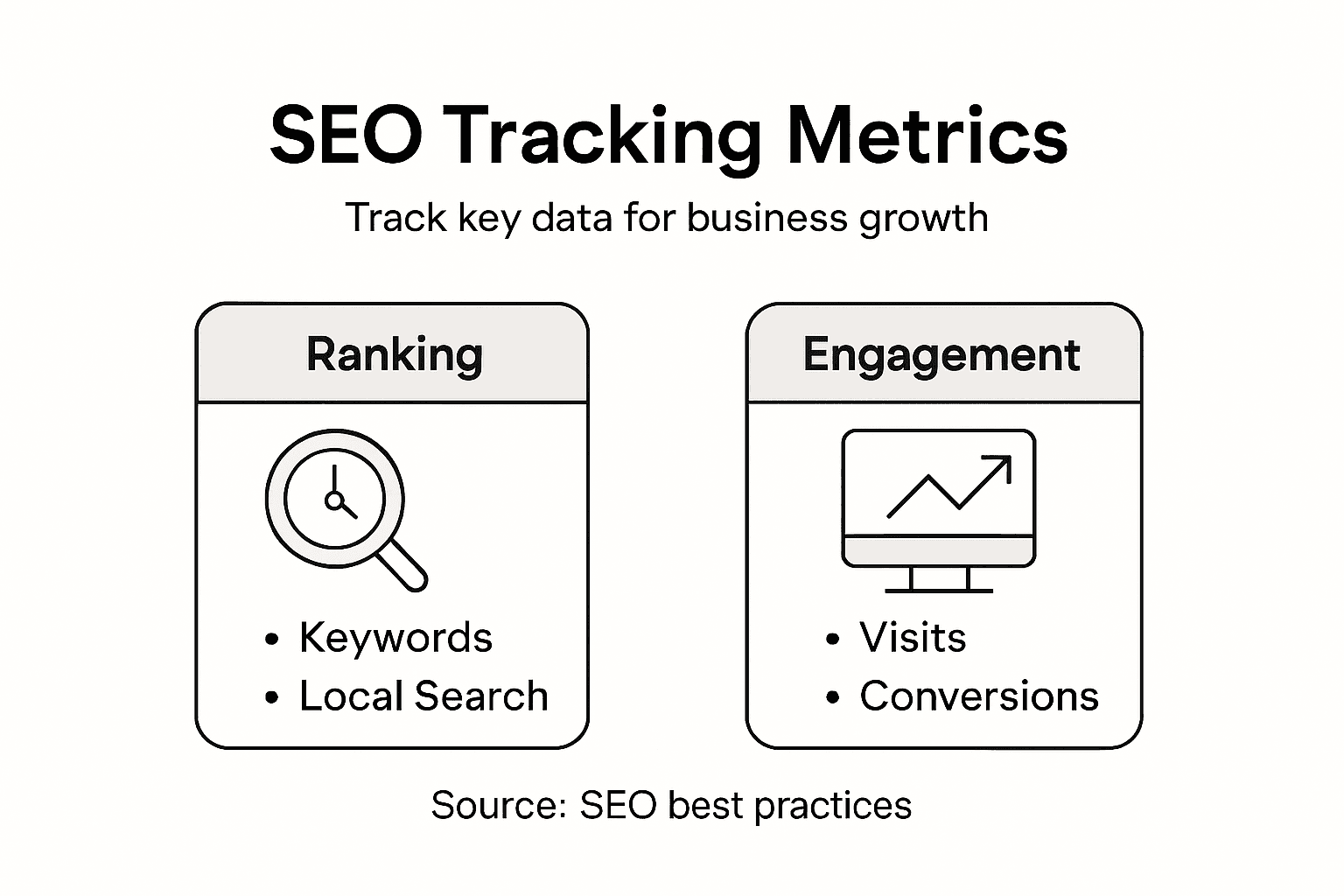
The first bucket of metrics involves keyword rankings and visibility. This is straightforward: where does your business rank when someone searches for your main services in your area? If you’re a dentist in Phoenix and you rank number one for “family dentist Phoenix,” that’s gold. If you’re on page three, most people never find you. Beyond individual keyword positions, you also track organic traffic volume, which shows how many people are actually arriving at your website from Google search. A dental practice might see 120 visitors from search in January and 180 in March, indicating growth. Tracking metrics like keyword rankings and organic traffic volume allows you to measure visibility and user engagement.
Then there are engagement and conversion metrics that reveal what happens once someone lands on your site. Your bounce rate tells you what percentage of people leave without exploring further—a high bounce rate often signals that your website or landing page isn’t matching what people expected. Your conversion rate is the real prize: what percentage of visitors actually contact you, call you, or fill out a form? A local business might discover that while they attract 200 monthly visitors from search, only 8 of them turn into actual customer inquiries. That’s a 4 percent conversion rate, which tells you there’s room to improve your website or messaging.
Don’t overlook local search metrics specific to your area. How many people are searching for your service in your city each month? Are those search volumes increasing or decreasing? How often does your Google Business Profile appear in search results versus your competitors? SEO metrics and measurements help evaluate your organic search effectiveness and identify areas for improvement. These localized numbers paint a picture of opportunity in your market.
Pro tip: Pick three metrics that matter most to your business (like keyword ranking for your main service, monthly contact inquiries from search, and Google Business Profile views) and check them every 30 days rather than obsessing over a hundred different numbers.
The table below summarizes the business impact of different SEO tracking metrics:
| Metric Type | What It Measures | Business Impact |
|---|---|---|
| Keyword Rankings | Position in search results | Higher ranks mean more visibility |
| Organic Traffic | Visitors from search engines | More traffic can yield more leads |
| Conversion Rate | Visitors who become customers | Measures true ROI of SEO efforts |
| Google Business Profile Views | Local listing exposure | Increased calls and store visits |
| Bounce Rate | Visitors who leave quickly | High rates indicate poor site match |
How SEO Tracking Improves Results
Tracking SEO isn’t just about collecting data. It’s about using that data to make smarter decisions that actually bring more customers to your business. When you see what’s working, you naturally do more of it. When you spot what’s not working, you fix it or try something different. This feedback loop is what transforms a stagnant online presence into a growing one.

Here’s the practical reality: without tracking, you’re flying blind. You might spend money on a website redesign, launch new service pages, or optimize your Google Business Profile, but you have no way to know if any of it actually helped. With tracking in place, you can see exactly what changed. Did phone calls increase by 23 percent after you added local service pages? Did your visibility in your neighborhood jump after you improved your business listing? Analyzing performance indicators like click-through rates reveals which rankings and features drive actual clicks from potential customers, enabling you to optimize your content and strategy accordingly. A plumbing company might discover that their “emergency plumbing” keywords drive far more calls than their “routine maintenance” keywords, so they adjust their content strategy to emphasize emergency services more heavily.
Tracking also helps you identify problems before they become expensive mistakes. Maybe your website has a high bounce rate from mobile visitors, meaning people are leaving immediately after arriving. Maybe your rankings improved but your conversion rate dropped, suggesting your landing page messaging doesn’t match what people are searching for. Effective SEO tracking provides insight into how different SEO techniques work to increase traffic and rankings, allowing you to monitor keyword performance, user behavior, and results so you can refine your strategy. Instead of spending money randomly hoping something sticks, you’re making data-driven adjustments that compound over time.
The real magic happens over months. A local business that tracks consistently sees patterns emerge. January might show strong searches for “holiday gift ideas” but weak searches for their main service. March might show the opposite. By understanding these seasonal patterns through tracking, you can adjust your content calendar and marketing spend to match when people are actually searching for what you offer. You start competing smarter instead of just harder.
Pro tip: Set up a simple monthly tracking spreadsheet with just four numbers: your top keyword ranking, monthly organic traffic, customer inquiries from search, and one conversion metric that matters to you, then review it every month to spot trends.
Key Tools and Methods for SEO Tracking
You don’t need to become a data analyst to track SEO effectively. The good news is that most of the tools you need are either free or affordable, and they integrate seamlessly into your workflow. The key is understanding which tools measure what, so you’re not drowning in dashboards filled with irrelevant numbers.
Google Analytics and Google Search Console are your foundation. Google Analytics shows you where your website traffic comes from, how long visitors stay, and which pages perform best. Google Search Console reveals which search queries bring people to your site, what your average ranking position is for different keywords, and technical issues that might prevent Google from indexing your pages. Together, these two free tools give you roughly 80 percent of what you need to track local SEO performance. A local contractor can see that Google Search Console reports 147 impressions for “contractor near me” last month, but only 12 clicks, indicating their ranking is decent but their search listing isn’t compelling enough to encourage clicks.
For more detailed keyword ranking tracking, you’ll want a specialized tool. SEO tracking utilizes keyword rank tracking, backlink monitoring, site audits, and analytics tracking to provide comprehensive analysis of SEO effectiveness. Tools like SEMrush, Ahrefs, or Moz track your specific keyword rankings daily and alert you when positions change. They also monitor your competitors, showing you which keywords they rank for and which you’re missing. Smaller businesses often find these tools pricey, which is why many focus on the free tier or use SEO Panel, an open-source platform offering keyword tracking, site audits, backlink monitoring, and automated reporting across multiple websites at minimal cost.
Simplify your tracking by creating a monthly routine. First, log into Google Search Console and note your top 10 keywords and average ranking positions. Second, check your Google Business Profile views and actions in the Insights section. Third, review Google Analytics traffic from organic search. Fourth, if using a ranking tool, note position changes for your priority keywords. Record these in a simple spreadsheet or Google Sheet you update monthly. This takes 20 minutes but gives you the complete picture of what’s working. Over time, these numbers tell a story about your local SEO progress that’s far more valuable than any single tool’s fancy dashboard.
Pro tip: Start with Google Analytics and Google Search Console only for your first three months, then add a ranking tracker once you’re comfortable reading the basic metrics.
Here’s a quick comparison of key SEO tracking tools for local businesses:
| Tool Name | Main Purpose | Cost Range | Ideal For |
|---|---|---|---|
| Google Analytics | Measure website traffic | Free | All business sizes |
| Google Search Console | Track search presence | Free | Tracking keyword performance |
| SEMrush | Detailed keyword tracking | Paid (high) | Advanced competitor analysis |
| Ahrefs | Backlink and rank analysis | Paid (high) | Deep technical SEO insights |
| SEO Panel | Multi-site tracking, audits | Free/Open Source | Budget-friendly, multiple sites |
| Moz | Keyword & link monitoring | Paid (mid-high) | Local SEO improvements |
Common Mistakes and Costly Pitfalls
Many small business owners start tracking SEO with genuine enthusiasm, only to stumble into traps that waste time and money. The good news is that these mistakes are predictable and avoidable once you know what to watch for. Understanding the pitfalls before you hit them saves you from costly detours.
The biggest mistake is tracking the wrong metrics. You might obsess over traffic volume without caring whether that traffic converts into actual customer inquiries. A dentist’s website might attract 500 monthly visitors but generate zero new patient calls. That’s a vanity metric masking a real problem. Common tracking mistakes include focusing on traffic volume without conversions and expecting immediate results without ongoing analysis, which can lead to misguided strategies and wasted budgets. The trap is easy to fall into because traffic numbers feel impressive, but they’re meaningless if nobody contacts you. Start tracking metrics that matter: customer inquiries from search, phone calls from local searchers, and form submissions. These are the numbers that actually impact your bottom line.
Another critical error is taking shortcuts that violate search engine guidelines. Some businesses hire agencies that use black-hat tactics like keyword stuffing, link schemes, or cloaking to artificially inflate rankings. Employing black-hat SEO tactics such as keyword stuffing, cloaking, or link schemes violates search engine guidelines and results in penalties or complete deindexing from search results. This sounds tempting when you’re desperate for quick results, but Google’s algorithms detect these tactics, and the penalty can destroy your visibility overnight. A business that spent months climbing to page one can plummet to page five or disappear entirely. The recovery process takes months or years. Patience and legitimate optimization strategies always win in the long run.
Don’t fall into the trap of misinterpreting data due to lack of context. Your rankings might drop in January because everyone is searching for holiday-related terms, not because your SEO got worse. Your traffic might spike because of seasonal demand, not because of the changes you made. Without understanding context, you’ll make decisions based on noise rather than signal. Track trends over three to six months rather than obsessing over week-to-week fluctuations. Also avoid relying on a single analytics tool. Google Search Console might show different data than your ranking tracker because they measure slightly different things. Use multiple sources to validate what you’re seeing before making major strategy changes.
Pro tip: Before making any major changes to your website or strategy based on tracking data, wait 30 days to confirm the trend is real and not just normal monthly fluctuation.
Take Control of Your Local SEO Success Today
Understanding the importance of SEO tracking shows you how crucial it is to monitor real metrics like keyword rankings, organic traffic, and customer inquiries. If the idea of managing these numbers feels overwhelming or time-consuming, you are not alone. Many small businesses struggle to transform SEO data into meaningful growth because they lack affordable and simple solutions that deliver consistent results. 99 Dollar Local SEO removes that burden by offering low-cost monthly services tailored to improve your local Google search and Google Maps rankings without the headaches of doing it yourself.
Stop guessing and start growing with a partner who knows how to optimize your Google Business Profile, build citations, and create content that drives calls and visits. Our transparent plans start at just $99 per month to give you measurable improvements in visibility and engagement right where your customers are searching. Don’t waste another month flying blind. Visit 99 Dollar Local SEO now to get started, learn more about our easy-to-understand Google Business Profile optimization, and discover how consistent SEO tracking with expert help can bring your local business the steady growth you deserve.
Frequently Asked Questions
What is SEO tracking?
SEO tracking involves monitoring how well your business appears in search results, measuring its performance, and understanding how potential customers find you online.
Why is SEO tracking important for local businesses?
SEO tracking is vital for local businesses because it helps determine how visible they are to customers in their area when searching for relevant services, enabling them to improve their strategies based on actual data.
What metrics should I focus on for effective SEO tracking?
Key metrics to focus on include keyword rankings, organic traffic volume, conversion rates, Google Business Profile views, and bounce rates. These metrics provide insights into visibility and customer engagement.
How can tracking SEO improve my business results?
By tracking SEO, you can identify what strategies are working or not, allowing you to make informed decisions that enhance visibility, attract more customers, and ultimately improve your business’s bottom line.